Space News
 American
Space News for 25 July 2017
American
Space News for 25 July 2017
Ancient Volcanoes on Mars Could Have Been the Place for Life
Universe Today - 25 Jul 2017 23:18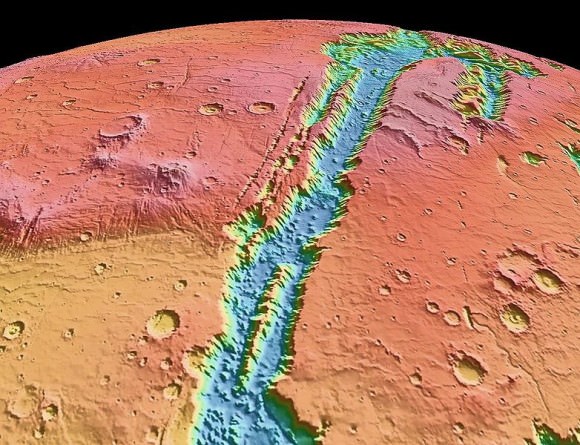 A new study by an international team of scientists has found evidence of recent volcanic activity on Mars, which could also lead to evidence of ancient life. The post Ancient Volcanoes on Mars Could Have Been the Place f...
Senate bill finds middle ground for NASA funding
Space News - 25 Jul 2017 23:05 A Senate appropriations subcommittee approved a spending bill July 25 that would provide NASA with $19.5 billion, striking a middle ground between the administration's original request and a more generous House bill. Spa...
Large, distant comets more common than previously thought
Phys.org - 25 Jul 2017 22:02 Comets that take more than 200 years to make one revolution around the sun are notoriously difficult to study. Because they spend most of their time far from our area of the solar system, many "long-period comets" will n...
Venus's Turbulent Atmosphere
SpaceRef - 25 Jul 2017 21:34
Venus is often referred to as Earth's twin because both planets share a similar size and sur-face composition. Also, they both have atmospheres with complex weather systems....
Good News for Future Moon Bases. There's Water Inside the Moon
Universe Today - 25 Jul 2017 20:37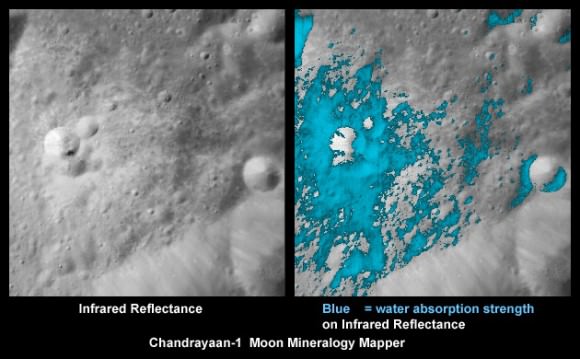 A new study by a team from Brown University has revealed evidence of widespread water on the lunar surface, which could also point towards water in the interior. The post Good News for Future Moon Bases. There’s Water ...
Carnival of Space #519
Universe Today - 25 Jul 2017 20:36
This week’s Carnival of Space is hosted by Brad Rogers at The Evolving Planet blog.
Op-ed | Federal agencies must modernize to be competitive and effective
Space News - 25 Jul 2017 19:41 Modern manufacturing and production is becoming increasingly complex, especially within highly regulated industries such as aerospace and defense. Ensuring quality in these industries can mean the difference between life...
Large, Distant Comets More Common Than Previously Thought
PTTU - 25 Jul 2017 19:04 NASA's Jet Propulsion Laboratory News and Features: Comets that take more than 200 years to make one revolution around the Sun are notoriously difficult to study. Because they spend most of their time far from our area o...
Long-Sought Self-Annihilating "Angel Particle" Detected --"Both Matter and Anti-Matter at Once"
The Daily Galaxy - 25 Jul 2017 17:57
"Our team predicted exactly where to find the Majorana fermion and what to look for as its 'smoking gun' experimental signature," said Zhang, a theoretical physicist and one of the senior authors of the research paper. "...
Team uses airborne telescopes to study Sun and Mercury during total solar eclipse
Phys.org - 25 Jul 2017 17:50 A team led by Southwest Research Institute will use airborne telescopes aboard NASA research aircraft to study the solar corona and Mercury's surface during this summer's total solar eclipse. The August 21 observations w...
Chasing the Total Solar Eclipse from NASA's WB-57F jets
Phys.org - 25 Jul 2017 17:38 For most viewers, the Aug. 21, 2017, total solar eclipse will last less than two and half minutes. But for one team of NASA-funded scientists, the eclipse will last over seven minutes. Their secret? Following the shadow ...
NASA Space Station On-Orbit Status 24 July 2017 - New Crew Ready for Flight
SpaceRef - 25 Jul 2017 17:14
A new International Space Station crew is less than a week away from beginning a 4-1/2 month mission living and working in space. The trio from the United States, Russia and Italy is in Kazakhstan counting down to a Frid...
Venus's turbulent atmosphere
Phys.org - 25 Jul 2017 16:43 Venus is often referred to as Earth's twin because both planets share a similar size and sur-face composition. Also, they both have atmospheres with complex weather systems. But that is about where the similarities end: ...
XCOR co-founder joins Deep Space Industries
Space News - 25 Jul 2017 16:12 Doug Jones, formerly chief test engineer at XCOR, will be the director of propulsion systems at Deep Space Industries, a company developing small satellites and other technologies needed for asteroid mining. SpaceNews.co...
What is the weather like on Mercury?
Phys.org - 25 Jul 2017 15:30 With the dawning of the Space Age in the 1950s, human beings were no longer confined to studying the Solar planets and other astronomical bodies with Earth-based instruments alone. Instead crewed missions have gone into ...
Volcanoes Reveal Water Deep Inside the Moon
The Daily Galaxy - 25 Jul 2017 15:25
"The growing evidence for water inside the Moon suggest that water did somehow survive, or that it was brought in shortly after the impact by asteroids or comets before the Moon had completely solidified," said Shau Li a...
Volcanoes Reveal Water Deep Inside the Moon --"May be That the Interior of the Moon is Wet"
The Daily Galaxy - 25 Jul 2017 15:25
"The growing evidence for water inside the Moon suggest that water did somehow survive, or that it was brought in shortly after the impact by asteroids or comets before the Moon had completely solidified," said Shau Li a...
New survey suggests far fewer Jupiter sized rogue planets than thought
Phys.org - 25 Jul 2017 15:25 (Phys.org)--A team of researchers with Warsaw University Observatory, Ohio State University and the University of Warwick has found evidence that suggests there are far fewer Jupiter-sized rogue planets roaming the Milky...
Rare Quadruple Gravitational Lense Discovered --"At the Forefront of Research in Cosmology"
The Daily Galaxy - 25 Jul 2017 15:04
Gravitational lenses are at the forefront of current research in cosmology and astrophysics. In astrophysics, they have been used to uncover the structure of massive galaxies, to study how supermassive black holes relate...
Cosmologists produce new maps of dark matter dynamics
Phys.org - 25 Jul 2017 14:59 New maps of dark matter dynamics in the Universe have been produced by a team of international cosmologists.
Earth from Space
ESA - 25 Jul 2017 14:45 President of the CNES French Space Agency, Jean-Yves Le Gall, and ESA's Josef Aschbacher discuss how cooperation will further benefit Earth observation activities and Copernicus
Russia's Mayak satellite: crowd-funded cosmic pest or welcome nightly visitor?
Phys.org - 25 Jul 2017 14:41 Will we soon see a new bright "star" visiting our evening skies? The crowd-funded Mayak CubeSat was launched along with 72 other satellites aboard a Russian Soyuz Rocket on July 14, 2017.
 Global
 Great Britain
 Indian
 South Africa